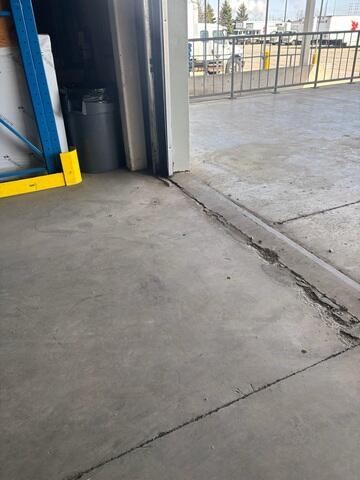
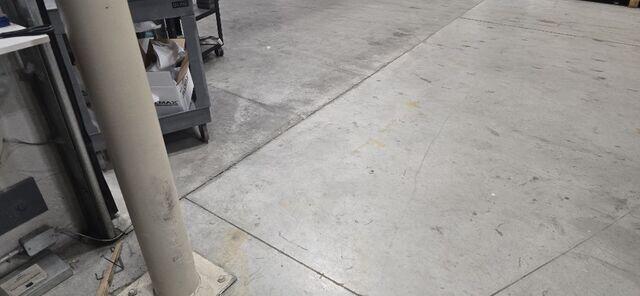
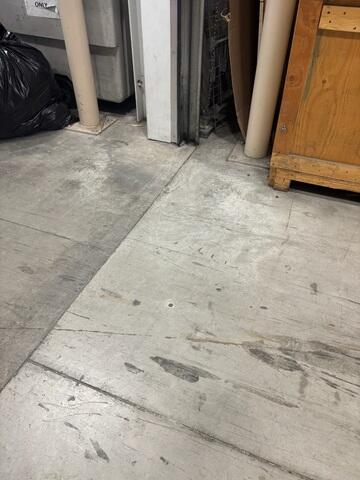
In this busy Mississauga, Ontario warehouse facility, daily operations were being significantly impacted by concrete failure at a critical transition zone between the interior slab and the loading bay doors. Over time, constant forklift traffic, heavy pallet loads, and repetitive loading cycles had caused the concrete slabs to settle and deteriorate under stress. This resulted in uneven transitions, slab displacement, and severe joint spalling, where the edges of the concrete had broken down into jagged, crumbling sections.
These conditions created more than just surface damage—they became ongoing operational and safety concerns. Forklift operators experienced repeated impact jolts when crossing the uneven joints, contributing to increased equipment wear and maintenance costs. In addition, the deteriorated slab edges introduced trip hazards for staff and reduced overall efficiency in a high-traffic industrial environment. Without intervention, continued settlement threatened further structural degradation and disruption to warehouse productivity.
Solution
To restore structural integrity without interrupting operations, Canadian Concrete Leveling implemented a precision polyurethane injection concrete leveling system. Small 5/8" access holes were strategically drilled through the affected slab areas, allowing for the injection of a high-density, closed-cell polyurethane material beneath the concrete. As the material expanded, it filled underlying voids in the subgrade and provided controlled lifting pressure to carefully raise the slabs back toward their original elevation.
This process stabilized the loading bay transition zone by reinforcing the base with a waterproof, load-bearing material designed to withstand heavy industrial traffic. Once the slabs were brought back to a level position, the damaged joints and spalled edges were addressed to restore a smooth and continuous surface across the forklift path.
Because the polyurethane cures rapidly and reaches functional strength within minutes, the warehouse was able to remain operational throughout the repair process and return to full use immediately after completion. The result was a fully stabilized, level, and durable loading area that improved safety for staff, reduced equipment strain, and restored efficient material handling flow throughout the Mississauga, Ontario facility.