Walkway Realignment and Sub-base Stabilization
Challenge
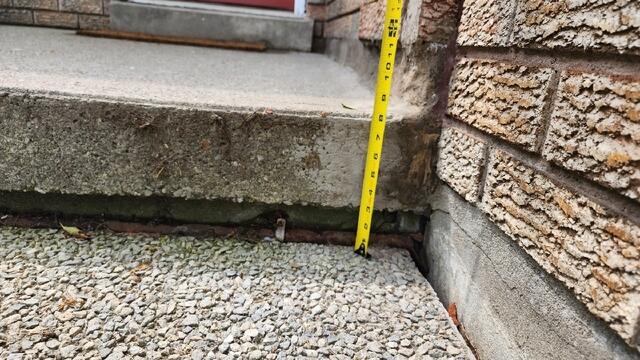
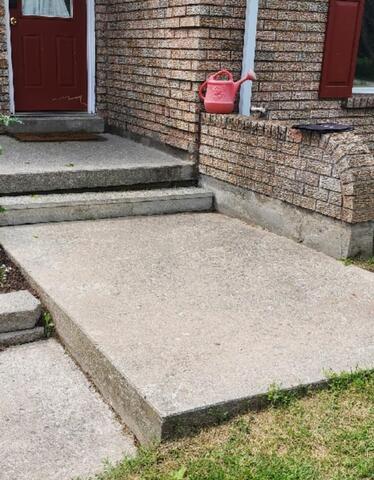
The front entrance of this Beaverton home faced a significant structural crisis that was both a safety hazard and a threat to the building's exterior. A massive, heavy concrete slab, which served as the primary walkway and landing, had begun to sink deep into the ground. As the measuring tape clearly documents, the slab had experienced a dramatic 3-inch vertical drop from its original position. This shift created a dangerous ledge between the landing and the walkway, posing a constant trip hazard for anyone approaching the front door.
The problem extended beyond just a safety risk. As the slab settled those three inches, it pulled away from the decorative brick retaining wall and the home's main foundation, leaving a visible void underneath the concrete. In a region like Beaverton, where soil can be prone to shifting and moisture levels vary, this gap acted as a funnel for rainwater. It directed moisture into the sub-base and toward the house rather than shedding it away. This cycle of erosion worsened the sinkage over time; as the soil beneath the multi-ton slab continued to wash away, the heavy concrete was left unsupported and increasingly unstable.
Solution
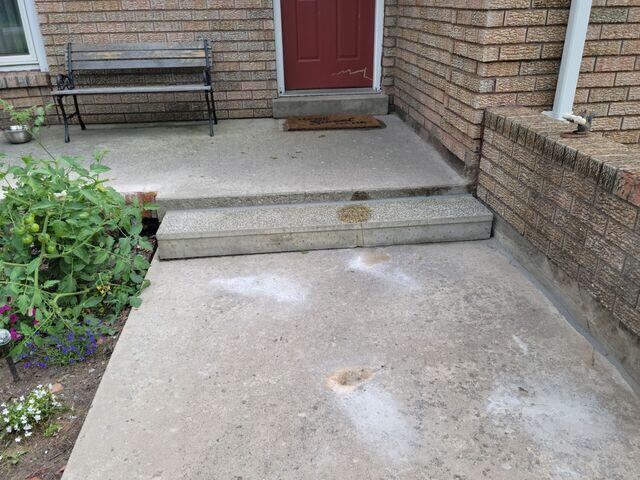
To address the failure without the cost and mess of a full demolition, the chosen solution was a sophisticated process known as polyurethane injection. This method targeted the root cause—the hollow space beneath the concrete—by using the slab itself as a bridge. Technicians began by drilling several small, penny-sized holes through the surface of the sunken walkway.
Through these ports, they injected a specialized, high-density structural polymer into the underlying cavity. As the two-part liquid material reacted, it underwent a powerful chemical expansion. This expansion filled the pockets of air and compacted the loose soil into a stabilized, load-bearing base.
The force of this reaction provided the necessary hydraulic lift to move the massive slab back up the three inches required to meet the landing. By carefully controlling the injection points, the team was able to "jack" the concrete back into alignment with the step and the brickwork, restoring the proper transition between surfaces. Once the lift was complete, the drill holes were patched with a concrete grout to blend in with the surrounding surface. The result was a stabilized walkway that was once again safe for use and supported by a waterproof foundation designed to resist the specific soil erosion issues found in the Beaverton area.